





Nature & Mountain

Outdoor Nature Training Why Leaving the Office Transforms Learning

Outdoor Nature Training Escaping the Office to Learn Better

Seminaire.com Team July 16, 2026 7 min read
Outdoor Nature Training Why Leaving the Office Transforms Learning

The office inhibits. Nature liberates. More and more companies are integrating outdoor nature training into their skills development strategy — and the results are often surprising. Increased focus, amplified creativity, improved retention: neuroscience validates what nature educators have always known.

Ready to Create Unforgettable Team Experiences?

Discover how we can help you plan retreats that your teams will truly remember.

The Proven Effects of Nature on Learning

🧠 Neuroscience findings

A University of Michigan study (2008, replicated 2023) shows that 50 minutes in a natural setting improves concentration and working memory by an average of 20 % compared to an urban walk.

  • 🌿 Stress reduction — Green spaces reduce cortisol (stress hormone) by 12–15 % within 20 minutes. Less stressed learners retain better.
  • 🎯 Increased concentration — Attention Restoration Theory (ART) demonstrates that nature restores directed attention capacities depleted by intensive work.
  • 💡 Amplified creativity — A Stanford study (2014) shows that walking — especially outdoors — increases creative thinking by an average of 81 %.
  • 🤝 Accelerated cohesion — Facing natural challenges (weather, terrain, navigation), teams develop authentic solidarity faster than in a room.

The Most Effective Outdoor Nature Training Formats

  • 🌲 Pedagogical forest bathing — Slow walk in the forest with presence and reflection exercises. Ideal for strategy and vision sequences.
  • 🧗 Outdoor challenge — Climbing, high ropes, via ferrata — the metaphors of overcoming obstacles are immediate and memorable.
  • 🌱 Permaculture workshop — Designing a garden space as a team — project management, roles, long-term planning, complementarity.
  • 🗺️ Navigation and orienteering — Compass, map, GPS — distributed leadership exercise, uncertainty management, communication.
  • 🔥 Bivouac & survival — Lighting a fire, building a shelter, cooking outdoors — basic skills, resourcefulness, humility.

How to Integrate Nature Training Into Your Seminar Programme
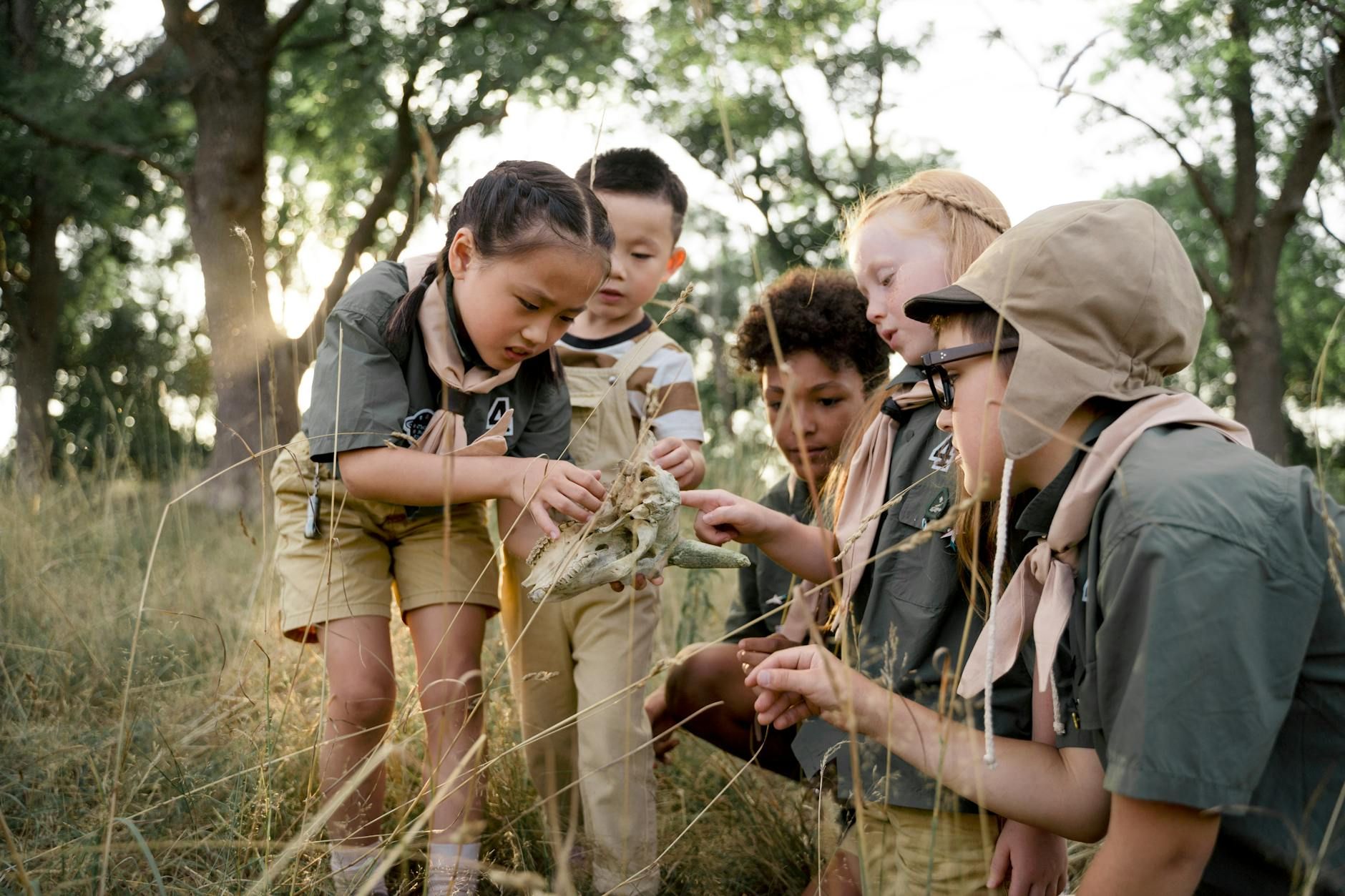
A group of scouts discovering an animal skull in a forest setting.

Optimal nature session duration: 2–4hIdeal group size: 8–15 people/groupRetention gain vs indoor: 25–35 %

🌤️ Weather: the non-negotiable prerequisite — Always prepare an equivalent indoor fallback programme. Equip delegates accordingly (clothing, footwear, sun protection).

👨‍🏫 Specialist facilitation — A nature trainer is not a hiking guide. They master both experiential pedagogy and outdoor safety. Check certifications and corporate references.

🔄 Structured debrief — A nature experience without a pedagogical debrief is team building, not training. Plan 30–45 minutes indoors to anchor the learning.

Discover our nature seminar destinations: Annecy, Basque Country, and many more.

❓ Frequently Asked Questions


Is outdoor nature training suitable for all teams?

It suits the vast majority of teams, with format adaptation. For delegates with reduced mobility, favour accessible activities (gardening, forest-edge sessions, seated nature observation). The key: physical challenges are optional, natural immersion is universal.


What is the ROI of outdoor nature training?

ROI is measured on 3 dimensions: retention (studies show +25–35 % vs indoor), engagement (delegate satisfaction 20–30 points higher on average) and application (skills put into practice more quickly when emotional anchoring is strong).


How do you choose a serious outdoor nature training provider?

Check: outdoor certifications, documented corporate experience (verifiable references), a written pedagogical programme (not just a list of activities), and specific outdoor activity insurance cover.

Ready to organize your next retreat?

Discover how we can help you create memorable experiences for your teams.

Create lasting memories with your team in inspiring locations


Create lasting memories with your team in inspiring locations

FAQ

Frequently Asked Questions: Outdoor Nature Training Why Leaving the Office Transforms Learning

Outdoor nature training offers a transformative alternative to traditional office-based learning by fostering increased focus, creativity, and retention. The article highlights how stepping outside the confines of an office liberates employees, allowing them to engage more deeply with training content and each other.

Neuroscience supports these benefits, showing that natural environments can amplify cognitive function and learning outcomes. Companies incorporating outdoor training often observe surprising results, such as improved team collaboration and more effective skills development.

To discover more insights and practical tips on implementing nature-based training, explore related articles in our blog section.

Integrating nature-based training into corporate skills development strategies can yield significant advantages. The article identifies key outcomes, including enhanced focus, increased creativity, and better retention of information among participants.

These improvements are not just anecdotal—neuroscience research backs up the positive impact of natural environments on learning processes. Companies that adopt outdoor training often report more engaged teams and a fresh perspective on problem-solving.

For organizations interested in these results, reviewing our corporate training blog posts can provide further guidance and examples.

Outdoor nature training is ideal for organizations seeking to invigorate their team’s learning and development programs. If your company values innovation, collaboration, or is looking to break free from traditional, office-bound training methods, this approach can offer distinct advantages.

Businesses of all sizes—from startups to large enterprises—can benefit, especially those aiming to foster creativity and deeper engagement among employees. The article suggests that any organization open to reimagining its training strategy could see measurable improvements.

To learn more about whether this approach fits your needs, browse our blog for further analysis and real-world case studies.

The article points to neuroscience research as strong evidence supporting the effectiveness of learning in natural environments. These studies demonstrate that being immersed in nature can boost cognitive functions such as focus and creativity while improving information retention.

Nature educators have long advocated these benefits, and now science validates their experience. Companies adopting outdoor training are seeing tangible improvements in their teams’ engagement and learning outcomes.

For more details on the science behind nature-based learning, explore our related blog posts and resources.

If your organization is considering outdoor nature training, the first step is to explore available programmes and success stories to determine the best fit for your team’s goals. The article encourages companies to break away from office habits and embrace new environments for learning.

Evaluate your objectives—whether boosting creativity, collaboration, or retention—and look for programmes that align with these needs. Engaging with expert facilitators or consulting with training providers can also be valuable next steps.

For inspiration and further guidance, visit our blog or reach out for more information about available training options.

CTA background

Ready to Plan Your Next Team Retreat?

Let our expert team help you create an unforgettable experience for your team. Get started in minutes.

Talk to our team